If you've spent any time researching light-based treatments for pain, you've probably come across two terms that sound similar but aren't the same thing: red light therapy and Class IV laser therapy. Both use light to support the body's healing process, and both fall under the same underlying science — but the similarities mostly end there.
Patients ask us about this often, especially since red light panels and masks have become popular for home use. Here's how the two compare, and how to know which one actually fits what you're dealing with.
What Is Red Light Therapy?
Red light therapy typically uses LED panels, pads, or masks that emit red and near-infrared light. It's widely available for home use and is commonly marketed for skin health, minor aches, and general wellness.
Because LED devices are low-powered and the light they produce is scattered rather than focused, red light therapy mainly affects tissue close to the surface of the skin. That makes it a reasonable option for things like mild surface-level soreness or general skin support, but it isn't designed to reach deeper structures like muscles, tendons, or joints.
What Is Class IV Laser Therapy?
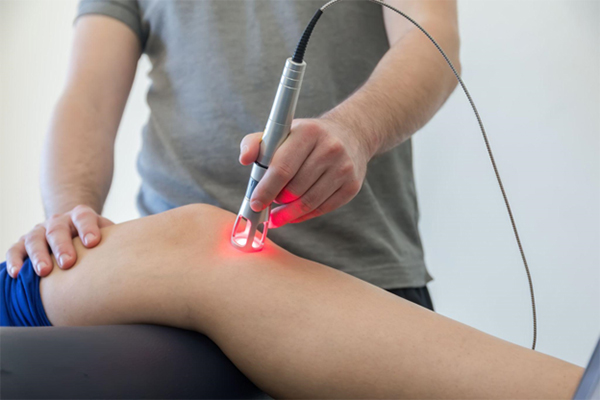
Class IV laser therapy — the kind we use in our office with the Remy laser — is a medical-grade treatment that uses a focused, coherent beam of near-infrared light at a much higher power output than LED devices. That higher power allows the light to penetrate well beyond the skin's surface, reaching muscle, tendon, ligament, and joint tissue.
How this works: the light energy is absorbed by cells and helps drive a process called photobiomodulation, which increases cellular energy production, calms inflammation, and speeds tissue repair.
Key Differences at a Glance
| Red Light Therapy | Class IV Laser Therapy | |
|---|---|---|
| Light source | LED panels, pads, or masks | Focused, coherent medical-grade laser |
| Power output | Low | High |
| Tissue depth | Superficial, near the skin's surface | Reaches deep into muscle, tendon, and joint tissue |
| Typical setting | Home use, spas, wellness centers | Medical and clinical settings, administered by trained providers |
| Best suited for | Mild soreness, skin support, general wellness maintenance | Chronic or deep-seated joint and soft tissue pain, tendon and ligament injuries, post-surgical recovery |
| Supervision needed | Minimal | Requires trained clinical administration and protective eyewear |
Both approaches rely on the same underlying principle of using light to stimulate the body's own healing response. The real difference comes down to power and depth — and that difference matters a lot when the goal is treating something like knee arthritis or a tendon injury rather than surface-level discomfort.
Which One Is Right for Me?
The right choice really depends on what you're trying to treat.
Red light therapy may be a reasonable fit if you're looking for a general wellness tool, mild and temporary muscle soreness relief, or ongoing at-home maintenance between clinical visits.
Class IV laser therapy tends to be the better choice if you're dealing with:
- Chronic or persistent joint pain, such as knee or hip osteoarthritis
- Tendon or ligament injuries that haven't responded to rest or home care
- Post-surgical swelling and stiffness
- Bursitis or other deeper inflammatory conditions
- Pain that hasn't improved with more conservative, surface-level approaches
If you're not sure which category your symptoms fall into, that's a conversation worth having with your provider. During your visit, we can evaluate what's actually going on and let you know whether Class IV laser therapy is likely to help — and how it might fit alongside the rest of your treatment plan.
Ready to Talk About Your Options?
If you've been relying on an at-home red light device without much relief, or you're simply trying to understand which option makes sense for your pain, our team at Elyussif Orthopedic & Knee Pain Center is happy to help you sort through it.
This blog is for general educational purposes and is not a substitute for individualized medical advice. Please consult your provider to determine if this treatment is appropriate for your specific condition.
AUTHOR: Eddie El-Yussif, DO, FAAOS – Board-Certified Orthopedic Surgeon
Eddie El-Yussif, DO, FAAOS is a board-certified orthopedic surgeon specializing in knee arthroplasty, including minimally invasive total knee replacement, partial knee replacement, and complex revision knee surgery. He has proudly served the Metropolitan Detroit community since 2009 and is committed to delivering patient-centered orthopedic care focused on restoring mobility and improving quality of life.
Credentials & Recognition
Dr. El-Yussif graduated with honors from the University of Virginia and earned his medical degree from Kansas City University of Medicine and Biosciences. He completed his Orthopaedic Surgery residency at Garden City Osteopathic Hospital in Garden City, Michigan, an affiliate of Michigan State University, where he served as Chief Resident and was actively involved in resident education. He received top national recognition for his research paper, Distal Femur Fractures in Osteopenic Patients: Plates vs. Nails.
Following residency, Dr. El-Yussif completed a prestigious knee arthroplasty fellowship at the Anderson Orthopaedic Research Institute in Alexandria, Virginia, where he trained alongside pioneers in joint replacement surgery. He holds the FAAOS distinction as a Fellow of the American Academy of Orthopaedic Surgeons, recognizing his expertise, commitment to patient care, and dedication to ongoing professional development. He also serves as a Clinical Instructor at Michigan State University School of Medicine.
Clinical Expertise
Dr. El-Yussif specializes in knee replacement, including advanced knee replacement techniques, minimally invasive total knee replacement, and partial knee arthroplasty. His approach emphasizes surgical precision, evidence-based treatment strategies, and comprehensive postoperative care to help patients return to active lifestyles as safely and efficiently as possible.
Medical Disclaimer: This information is for educational purposes only and does not constitute medical advice. For diagnosis and treatment recommendations, please consult with Dr. El-Yussif or another qualified orthopedic specialist.
Content authored by Dr. Eddie El-Yussif and verified against official sources.