Partial Knee Replacement in Clinton Township, MI
If knee arthritis is affecting only one part of your knee, a partial knee replacement may provide effective pain relief while preserving more of your natural joint. Also known as unicompartmental knee replacement, this advanced surgical procedure is designed for patients with localized knee arthritis who may not require a total knee replacement. At Elyussif Orthopedic & Knee Pain Center in Clinton Township, MI, Dr. Eddie El-Yussif specializes in partial knee replacement procedures that help patients restore mobility, reduce pain, and return to the activities they enjoy.
Unlike total knee replacement, which replaces the entire knee joint, partial knee replacement focuses only on the damaged compartment of the knee. By preserving healthy bone, cartilage, and ligaments, this procedure may offer a more natural-feeling knee and a potentially faster recovery for appropriately selected patients. Dr. El-Yussif carefully evaluates each patient's condition to determine the most suitable treatment option based on their symptoms, imaging findings, and lifestyle goals.
Patients throughout Clinton Township, Lenox, Macomb County, and surrounding Michigan communities trust Elyussif Orthopedic & Knee Pain Center for personalized orthopedic care and advanced joint preservation solutions.
What is Unicompartmental Knee Replacement?
Unicompartmental knee replacement is a minimally invasive surgery in which only the damaged compartment of the knee is replaced with an implant. It is also called a partial knee replacement.
The knee can be divided into three compartments: patellofemoral, the compartment in front of the knee between the kneecap and thighbone, the medial compartment, on the inside portion of the knee, and lateral compartment which is the area on the outside portion of the knee joint.
What is Arthritis?
Arthritis is the inflammation of a joint that causes pain, swelling (inflammation) and stiffness.
Osteoarthritis is the most common form of knee arthritis, in which the joint cartilage gradually wears away. It most often affects older people. In a normal joint, articular cartilage allows for smooth movement within the joint, whereas in an arthritic knee the cartilage itself becomes thinner or completely absent. In addition, the bones become thicker around the edges of the joint and may form bony spurs. These factors can cause pain and restricted range of motion in the joint.
How is Arthritis Diagnosed?
Your doctor will diagnose osteoarthritis based on your medical history, physical examination, and X-rays. X-rays typically show a narrowing of joint space in the arthritic knee.
What are the Indications for Unicompartmental Knee Replacement?
Traditionally, total knee replacement was commonly indicated for severe osteoarthritis of the knee. In total knee replacement, all worn out or damaged surfaces of the knee joint are removed and replaced with new artificial parts. Partial knee replacement is a surgical option if your arthritis is confined to a single compartment of your knee.
Your doctor may also recommend surgery if non-surgical treatment options such as medications, injections, and physical therapy have failed to relieve the symptoms.
How is Unicompartmental Knee Replacement Surgery Performed?
During the surgery, a small incision is made over the knee to expose the knee joint. Your surgeon will remove only the damaged part of the meniscus and place the implant into the bone by slightly shaping the shinbone and the thighbone. The plastic component is placed into the newly prepared area and secured with bone cement. Now, the damaged region of the femur or thighbone is removed to accommodate the new metal component, which is fixed in place using bone cement. Once the femoral and tibial components are fixed in proper place the knee is taken through a range of movements. The muscles and tendons are then repaired and the incision is closed.
What Does Postoperative Care for Unicompartmental Knee Replacement Involve?
You may walk with the help of a walker or cane for the first 1-2 weeks after surgery. A physical therapist will introduce you to an exercise program to follow for 4 to 6 months to help maintain range of motion and restore your strength. You may perform exercises such as walking, swimming, and biking but high impact activities such as jogging should be avoided.
What are the Risks and Complications of Unicompartmental Knee Replacement?
The possible risks and complications associated with unicompartmental knee replacement include:
- Knee stiffness
- Infection
- Blood clots (Deep vein thrombosis)
- Nerve and blood vessel damage
- Ligament injuries
- Patella (kneecap) dislocation
- Wearing of the plastic liner
- Loosening of the implant
What are the Advantages of Unicompartmental Knee Replacement?
The advantages of unicompartmental knee replacement over total knee replacement include:
- Smaller incision
- Less blood loss
- Quick recovery
- Less postoperative pain
- Better overall range of motion
- Feels more like a natural knee
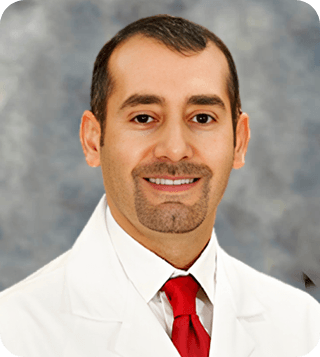
Dr. Eddie El-YussifBoard Certified Orthopedic Surgeon, and Fellow of the American Academy of Orthopedic Surgeon
Dr. Eddie El-Yussif made Metropolitan Detroit his home in August of 2009. Raised in Fairfax County, Virginia, Dr. El-Yussif graduated with honors from The University of Virginia, received his medical degree at The Kansas City University of Medicine and Biosciences, and completed his residency in Orthopaedic Surgery at Garden City Osteopathic Hospital (Garden City, MI), an affiliate of Michigan State University.
Why Choose Dr. Eddie El-Yussif for Unicompartmental/Partial Knee Replacement?
Choosing the right orthopedic surgeon is essential when considering knee replacement surgery. Dr. Eddie El-Yussif is a fellowship-trained orthopedic surgeon with extensive experience in knee reconstruction, joint replacement, and advanced orthopedic procedures. His specialized expertise allows him to identify patients who may benefit from partial knee replacement and develop individualized treatment plans designed to optimize outcomes.
Dr. El-Yussif takes a patient-centered approach to care, carefully evaluating the extent of arthritis, knee alignment, ligament stability, activity level, and overall health before recommending surgery. His goal is to preserve as much healthy joint structure as possible while relieving pain and improving function.
At Elyussif Orthopedic & Knee Pain Center, patients benefit from comprehensive evaluations, advanced surgical techniques, modern implant technology, and personalized recovery plans. Dr. El-Yussif is committed to helping patients achieve lasting results while maintaining the highest standards of orthopedic care.
What Is Partial Knee Replacement?
Partial knee replacement, also called unicompartmental knee replacement, is a surgical procedure that replaces only the damaged compartment of the knee while preserving the healthy portions of the joint.
The knee consists of three compartments:
- Medial (inner) compartment
- Lateral (outer) compartment
- Patellofemoral (front) compartment
When arthritis affects only one compartment, partial knee replacement may be an effective alternative to total knee replacement. The procedure removes damaged bone and cartilage from the affected area and replaces it with specialized implant components designed to restore smooth joint movement.
Conditions Commonly Treated with Partial Knee Replacement
Partial knee replacement may be recommended for patients experiencing:
- Localized knee osteoarthritis
- Bone-on-bone arthritis affecting one compartment
- Chronic knee pain limited to a specific area
- Knee stiffness
- Reduced mobility
- Degenerative joint disease affecting a single compartment
- Functional limitations caused by compartment-specific arthritis
A comprehensive orthopedic evaluation helps determine whether partial knee replacement is the most appropriate treatment option.
Benefits of Partial Knee Replacement
For appropriately selected patients, partial knee replacement offers several potential advantages.
Benefits may include:
- Preservation of healthy bone and cartilage
- Smaller surgical incision
- Reduced tissue disruption
- More natural knee movement
- Faster recovery compared to total knee replacement
- Reduced postoperative discomfort
- Improved mobility
- Long-term pain relief
- Enhanced quality of life
Individual outcomes vary depending on patient health, activity level, severity of arthritis, and participation in rehabilitation.
Personalized Surgical Planning
Successful partial knee replacement begins with a thorough evaluation and precise surgical planning. Dr. El-Yussif carefully reviews imaging studies, physical examination findings, and patient goals to determine whether a unicompartmental approach is appropriate.
Every treatment plan is tailored to the patient's anatomy, degree of arthritis, and functional needs. This personalized approach helps maximize implant performance and long-term joint function.
Recovery After Partial Knee Replacement
Recovery following partial knee replacement is often faster than recovery from a total knee replacement because less bone and soft tissue are affected during surgery.
Patients typically begin walking shortly after surgery and participate in physical therapy to restore strength, flexibility, and mobility. Most patients gradually return to daily activities as healing progresses.
Dr. El-Yussif provides individualized recovery plans and ongoing support throughout rehabilitation to help patients achieve the best possible outcomes.
Preserving Function and Supporting Active Living
The primary goal of partial knee replacement is to relieve pain while preserving as much of the natural knee as possible. Many patients appreciate the ability to maintain a more natural-feeling joint and return to activities that were previously limited by arthritis.
Whether your goal is walking comfortably, remaining active, traveling, or enjoying recreational activities, Dr. El-Yussif works closely with you to develop a treatment strategy that supports your long-term mobility and quality of life.
Frequently Asked Questions About Partial Knee Replacement
What is partial knee replacement?
Partial knee replacement is a surgical procedure that replaces only the damaged compartment of the knee while preserving healthy bone, cartilage, and ligaments in the unaffected areas.
How is partial knee replacement different from total knee replacement?
Total knee replacement replaces all compartments of the knee joint, whereas partial knee replacement addresses only the damaged compartment, preserving more of the natural knee structure.
Who is a candidate for partial knee replacement?
Patients with arthritis confined to a single knee compartment, stable ligaments, and relatively healthy surrounding joint structures may be candidates for partial knee replacement.
What are the benefits of partial knee replacement?
Potential benefits include preservation of healthy tissue, smaller incisions, faster recovery, improved range of motion, and a more natural-feeling knee.
Is partial knee replacement a major surgery?
Yes, it is a surgical procedure, but it is generally less extensive than total knee replacement because only a portion of the joint is replaced.
How long does recovery take?
Recovery varies among patients, but many individuals experience a faster recovery compared to total knee replacement. Physical therapy remains an important part of the rehabilitation process.
How long do partial knee implants last?
Modern implants are designed for long-term durability. Longevity depends on factors such as activity level, overall health, implant type, and adherence to post-operative recommendations.
Can a partial knee replacement be converted to a total knee replacement later?
In some cases, if arthritis progresses to other compartments of the knee, conversion to a total knee replacement may become necessary in the future.
Schedule a Partial Knee Replacement Consultation in Clinton Township, MI
If localized knee arthritis is limiting your mobility and quality of life, partial knee replacement may offer an effective solution while preserving more of your natural joint. Dr. Eddie El-Yussif and the team at Elyussif Orthopedic & Knee Pain Center provide advanced unicompartmental knee replacement procedures for patients throughout Clinton Township, Lenox, Macomb County, and neighboring Michigan communities.
Our goal is to help patients achieve lasting pain relief, improved function, and a successful return to daily activities through personalized treatment plans and expert orthopedic care. From your initial consultation through recovery and rehabilitation, we are committed to supporting your journey every step of the way.
Contact Elyussif Orthopedic & Knee Pain Center today to schedule your Partial Knee Replacement consultation in Clinton Township, MI, and learn whether a unicompartmental knee replacement may be the right option for your condition. Take the first step toward improved mobility, reduced pain, and a more active lifestyle.