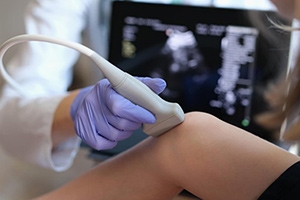
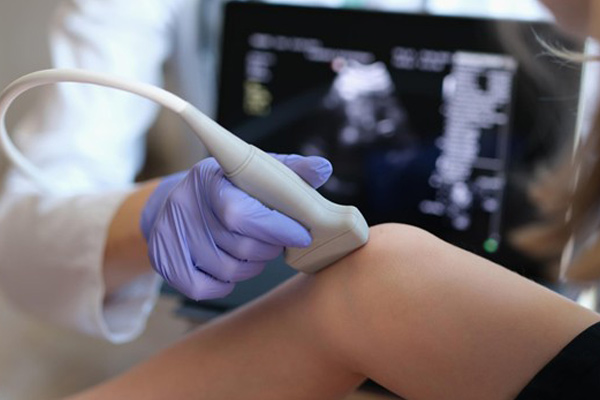
At The Knee Pain Center, we use advanced musculoskeletal ultrasound to deliver faster answers and more precise care. This technology allows us to diagnose joint, muscle, and tendon injuries in real time and perform targeted, image-guided treatments—all in the same visit.
If you’re experiencing knee pain or any other musculoskeletal condition, our ultrasound-guided approach helps us precisely identify the source of the problem, so you can start effective treatment sooner and return to the activities you enjoy.
The Science: How It Works
At its core, ultrasound is based on high-frequency sound waves.
- Emission: A handheld probe (transducer) sends sound waves into the knee.
- Reflection: These waves hit different tissues—like bone, muscle, or tendons—and bounce back.
- Processing: Since bones are dense, they reflect waves strongly (appearing white), while fluid allows waves to pass through (appearing black).
- The Result: A computer converts these echoes into a live video of your internal anatomy.
How Is Ultrasound Used in Orthopedic and Sports Medicine?
- Accurate, Real-Time Diagnosis
Ultrasound is excellent for diagnosing many common orthopedic conditions, including:
- Rotator cuff tears
- Tendonitis and tendinosis (Achilles, rotator cuff, patellar, elbow, etc.)
- Muscle strains and tears
- Knee Bursitis
- Ligament injuries
- Nerve entrapment (such as carpal tunnel syndrome)
- Joint effusions (fluid in the joint)
Because the imaging is performed during your visit, diagnosis can often be made immediately, without waiting days or weeks for advanced imaging.
- Dynamic Imaging
One of ultrasound’s biggest advantages is that it allows us to examine structures while you move. For example, we can watch a tendon glide, evaluate instability, or reproduce symptoms in real time—something MRI and CT scans cannot do.
- Guided Injections and Procedures
Ultrasound dramatically improves the accuracy of orthopedic injections by allowing the physician to see the needle enter the exact target area.
This is especially important for:
- Cortisone injections
- Platelet-rich plasma (PRP)
- Joint injections
- Tendon sheath injections
- Aspiration of fluid
- Minimally invasive procedures like percutaneous tenotomy
Studies show that ultrasound-guided injections are more accurate, more effective, and often less painful than “blind” injections.
Advantages of Ultrasound for Patients
- No radiation
- Safe and repeatable
- Real-time diagnosis
- Performed during your visit
- Lower cost compared to MRI
- Improves injection accuracy and outcomes
Fundamentals of Musculoskeletal Ultrasound
Jacobson JA. Fundamentals of Musculoskeletal Ultrasound. 3rd ed. Elsevier; 2018.
Diagnostic Ultrasound: Musculoskeletal
Ohana M, Bianchi S, eds. Diagnostic Ultrasound: Musculoskeletal. 2nd ed. Elsevier; 2020.
About the Author: Dr. Kyle Samyn, DO, CAQSM, RMSK
Kyle Samyn, DO, CAQSM, RMSK, is a board-certified, fellowship-trained sports medicine physician specializing in non-surgical orthopedic care, ultrasound-guided procedures, and orthobiologic treatments designed to help patients return safely to activity. With advanced expertise in musculoskeletal diagnosis and minimally invasive treatment strategies, Dr. Samyn focuses on evidence-based care for athletes and active individuals of all ages.
A Michigan native, Dr. Samyn completed his Family Medicine residency through the Henry Ford Health system in Warren, Michigan, where he developed a strong foundation in comprehensive patient care. He went on to complete specialized Sports Medicine Fellowship training at Henry Ford Providence Hospital, gaining advanced experience in diagnostic ultrasound, sports injury management, regenerative medicine techniques, and minimally invasive tendon and joint procedures.
Dr. Samyn holds dual board certification in Family Medicine and Sports Medicine through the American Board of Family Medicine and has earned the Registered in Musculoskeletal Sonography (RMSK) credential through the American Registry for Diagnostic Medical Sonography, demonstrating advanced proficiency in ultrasound-based diagnosis and image-guided treatment. His use of real-time musculoskeletal ultrasound allows for highly precise evaluations and targeted procedures that improve diagnostic accuracy and patient outcomes.
In addition to clinical practice, Dr. Samyn has served as a team physician at both high school and collegiate levels, supporting athlete injury prevention, performance optimization, and safe return-to-play decisions. He remains actively involved in medical education, national committee participation, and peer-reviewed research focused on advancing sports medicine care.
Dr. Samyn is committed to helping patients move better, recover faster, and avoid unnecessary surgery whenever possible. His patient-centered approach combines leading medical technology with individualized treatment planning to restore function and improve long-term musculoskeletal health.
Outside of medicine, he enjoys spending time with his wife and three children, as well as golfing, fishing, working out, and following sports.